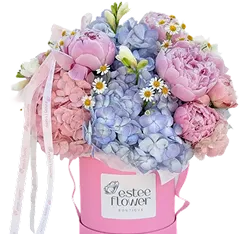
Flowers for Shavuot
Flowers for Shavuot can carry much more meaning than a simple spring bouquet. Shavuot is connected with the giving of the Torah at Mount Sinai, but it is also a harvest holiday, a celebration of wheat, first fruits, abundance, fragrance, greenery, and Jewish continuity. When we choose flowers for this holiday, we look not only at color, but also at the story behind the arrangement.
A Shavuot bouquet can speak about Mount Sinai in bloom. A basket arrangement can echo bikkurim, the first fruits brought to the Temple. Wheat stalks and grasses can remind us of Chag HaKatzir, the Harvest Festival. Warm red, orange, yellow, and coral flowers can suggest fire, revelation, and the awe of Sinai. This is what makes Shavuot floral design so rich. It does not have to be limited to one palette or one style.
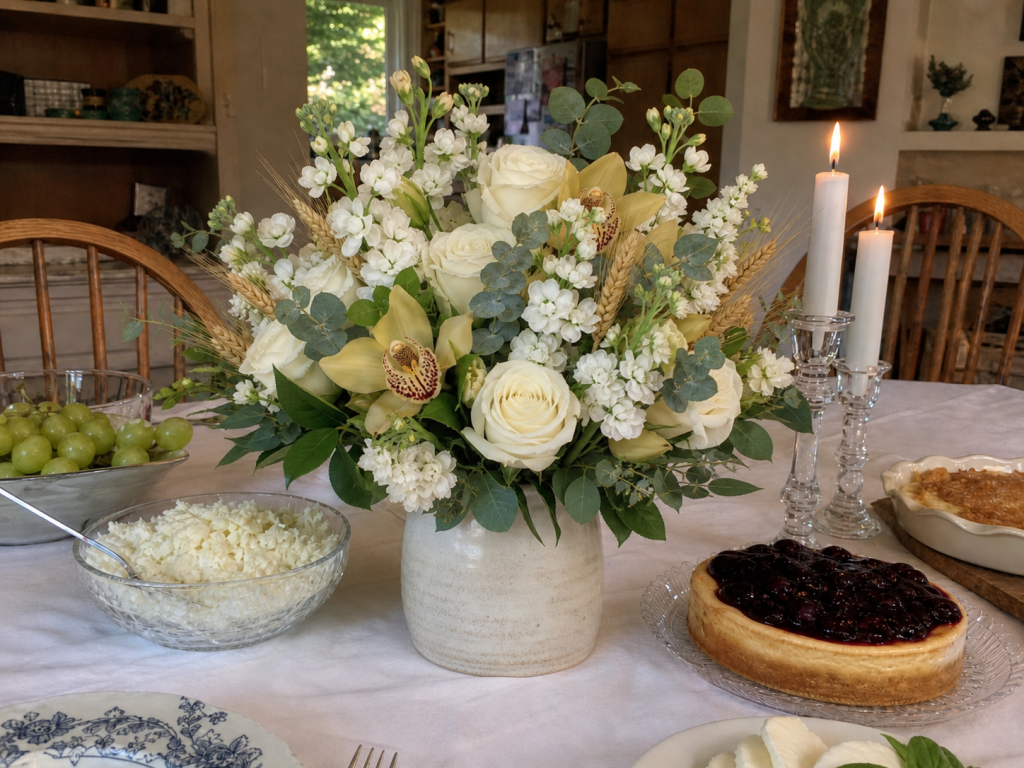
Flowers for Shavuot Miami
For Miami homes, synagogues, hotels, condos, and holiday tables, format matters as much as flowers. A hand-tied bouquet is beautiful when the recipient has a vase ready. A basket, hat box, ceramic vase arrangement, orchid centerpiece, or flowers in a box are more practical when the flowers are sent as a gift and the host is already busy preparing for Yom Tov.
In our work, we often think of Shavuot flowers through several layers at once: Torah, harvest, greenery, fragrance, first fruits, family meals, synagogue spaces, and the practical reality of South Florida life.
Why the Jewish festival of Shavuot has such a strong connection with flowers
The Jewish festival of Shavuot is one of the Three Pilgrimage Festivals. It comes after the counting of the Omer and is celebrated on the 6th of Sivan. In Israel, Shavuot is observed for one day, while many communities in the Diaspora observe it for two days. Jewish Museum Berlin explains that Shavuot comes seven weeks after Passover and is connected with the giving of the Ten Commandments at Mount Sinai.
Shavuot also has agricultural names and meanings. Chabad notes that Shavuot is called Chag HaKatzir, the Harvest Festival, and Yom HaBikkurim, the Day of First Fruits. It is connected with the wheat harvest and the beginning of the season for bringing first fruits to the Temple.
Jewish festival of Shavuot
That is why Shavuot flowers should not be treated like ordinary spring décor. White flowers and greenery are beautiful, but they are only one possible direction. Wheat, barley-like textures, baskets, fruit tones, fragrant flowers, garden-style blooms, and flame colors can all be meaningful when used thoughtfully.
Mount Sinai in bloom
One of the best-known explanations for Shavuot flowers is the tradition that Mount Sinai bloomed when the Torah was given. Chabad explains that many communities decorate homes and synagogues with flowers and greenery for Shavuot and connects this custom with the idea that the mountain blossomed in honor of the Torah.
My Jewish Learning also describes the custom of decorating homes and synagogues with fresh greens, flowering plants, boughs, and floral arrangements for Shavuot.
For floral design, this gives us a soft and natural direction: greenery, white flowers, flowering branches, garden textures, fragrant blooms, and airy arrangements. This concept works well for home tables, synagogue entrances, kiddush rooms, buffet tables, and reception spaces.
A Mount Sinai-inspired arrangement does not need to look dramatic. It can be quiet and graceful. White roses, hydrangeas, lisianthus, orchids, tulips, stock, chamomiles, and fresh greenery can create the feeling of a mountain that has suddenly come alive.
Wheat harvest and first fruits
Shavuot is also a harvest holiday. My Jewish Learning explains that Shavuot is tied to the spring harvest and the ancient practice of bringing bikkurim, the first fruits, to the Temple.
This side of the holiday is often overlooked, but it gives floral design much more depth. Wheat stalks, dried grasses, cream flowers, beige tones, honey colors, olive green, and basket arrangements can make Shavuot décor feel more connected to its agricultural roots.
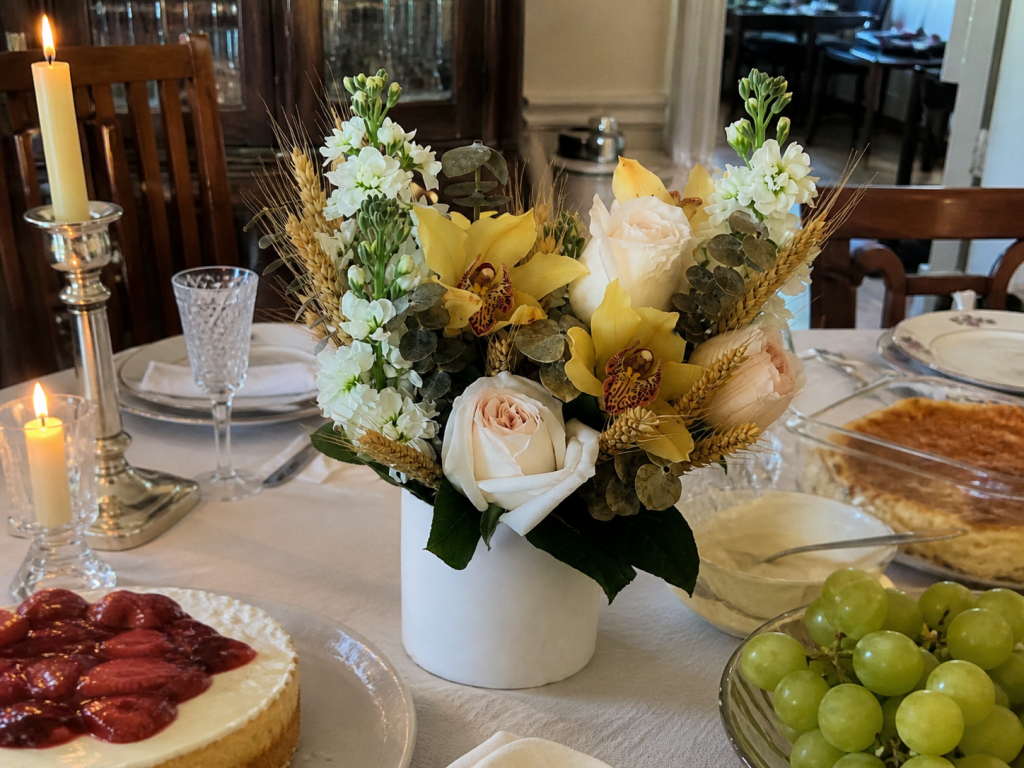
Shavuot décor
A basket with flowers and wheat accents is not only convenient. It quietly reflects the image of first fruits brought with care and gratitude. A table arrangement with grasses and soft garden flowers can suggest harvest fields without becoming rustic or heavy. For a Miami home, this can still look elegant and fresh, especially when combined with peonies, garden roses, hydrangeas, tulips, or ranunculuses.
Bikkurim baskets and the Seven Species
Baskets are one of the most meaningful formats for Shavuot. Chabad explains that the baskets of first fruits were decorated with flowers and greenery.
This makes a floral basket especially appropriate for the holiday. It can suggest bikkurim without turning the arrangement into a literal historical display. We can use soft flowers, greenery, wheat, fruit-inspired colors, or natural textures to make the design feel connected to Shavuot while still looking refined.
The Seven Species also offer inspiration. My Jewish Learning lists them as wheat, barley, grapes, figs, pomegranates, olives, and dates. In flowers, that can translate into wheat beige, olive green, pomegranate red, grape purple, fig tones, and date-honey gold. These colors can be used subtly in a bouquet, basket, or synagogue arrangement.
Fire, revelation, and warm color palettes
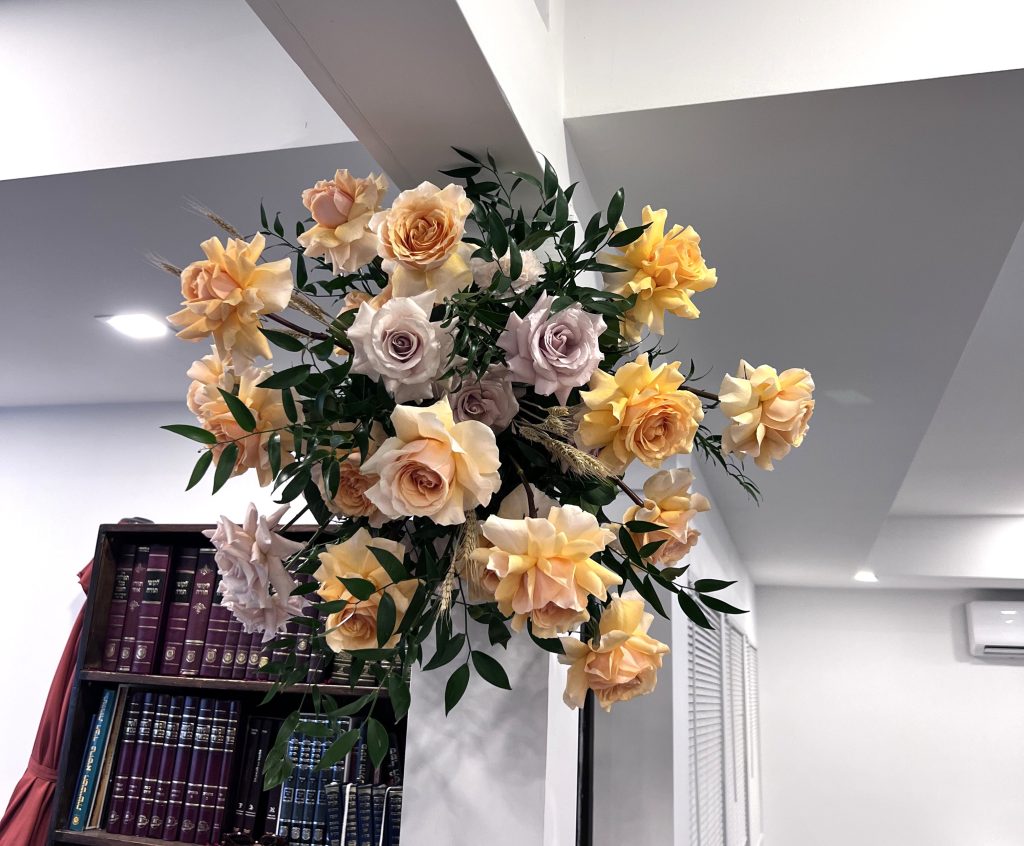
White and green are classic for Shavuot, but they are not the only meaningful choice. The revelation at Mount Sinai is described with thunder, lightning, smoke, and fire. Because of that, warm arrangements in red, orange, yellow, coral, and gold can also be appropriate, especially for synagogue décor or event installations.
A flame-inspired design should not look like a romantic red bouquet. It should feel like movement, light, warmth, and awe. Coral peonies, orange ranunculuses, yellow roses, red garden roses, golden textures, and warm seasonal flowers can be arranged to suggest fire and revelation.
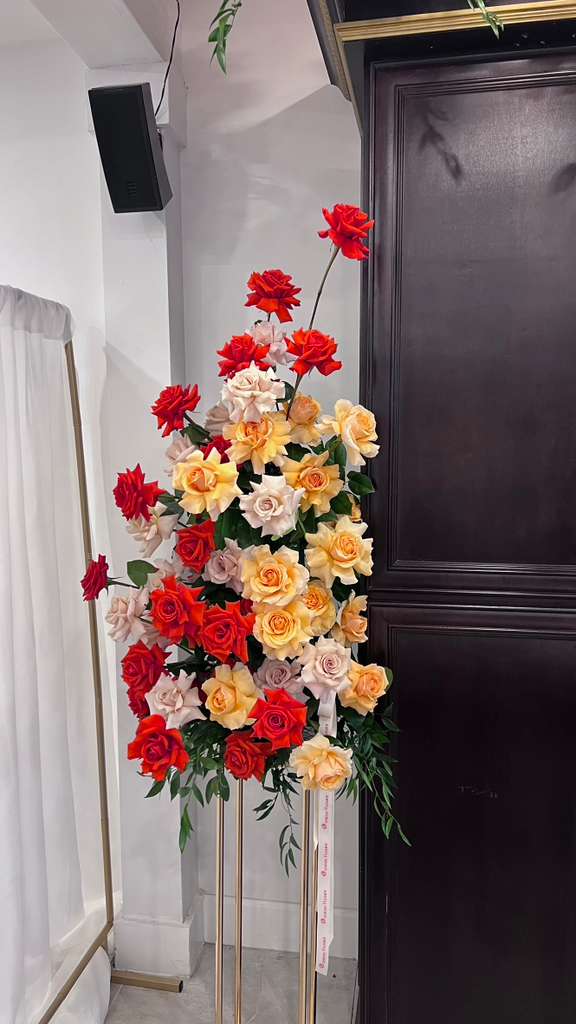
Fire, revelation, and warm color palettes (Synagogue Décor)
We especially like this concept for larger spaces. In a synagogue, an entrance area or event hall can carry a stronger visual idea than a small home table. A flame palette can be powerful when it is balanced with greenery and a clear structure, so the arrangement feels expressive rather than overloaded.
Understanding What is Shavuot in Judaism through flowers
What is Shavuot in Judaism is not only a question about a date. It is a question about meaning. Shavuot celebrates receiving the Torah, but it also marks a season of harvest, gratitude, study, and renewal.
Chabad describes Shavuot as the holiday when the Jewish people received the Torah at Mount Sinai. It also lists common customs such as hearing the Ten Commandments, studying Torah, eating dairy foods, reading the Book of Ruth, and decorating with greenery and flowers.
Aish also explains Shavuot through the counting of seven weeks after Passover, the giving of the Torah, and the agricultural background of the holiday.
For flowers, this means the holiday can be interpreted through different ideas.
| Shavuot idea | Floral interpretation | Best format |
| Mount Sinai blooming | Greenery, white flowers, flowering branches | Centerpieces, synagogue décor, home bouquets |
| Wheat harvest | Wheat stalks, grasses, cream tones, beige textures | Baskets, table arrangements, buffet décor |
| Bikkurim, first fruits | Baskets, fruit-inspired colors, abundance | Gift baskets, entrance arrangements |
| Torah and purity | White roses, orchids, lisianthus, hydrangeas | Home table, synagogue, host gift |
| Fire at Sinai | Red, orange, yellow, coral, gold flowers | Synagogue installation, event décor |
| Fragrance and sweetness | Stock, garden roses, seasonal fragrant flowers | Holiday table, entry bouquet |
Main Traditions of Shavuot and how they inspire flowers
The main Traditions of Shavuot include Torah study, hearing the Ten Commandments, eating dairy foods, decorating with flowers and greenery, reading the Book of Ruth in many communities, and remembering the harvest and first fruits.
Each tradition can inspire a different type of floral design.
Torah study and night learning
Many communities have the custom of staying up at night to learn Torah on Shavuot. Flowers near a learning table, synagogue lobby, or community study area should feel calm and respectful. White roses, hydrangeas, orchids, tulips, lisianthus, and gentle greenery work well here because they add beauty without visual noise.
Dairy meals
Shavuot meals often include cheesecake, blintzes, cheese boards, salads, fish, fruit, and light desserts. The flowers should leave room for food and conversation. A low centerpiece, bud vases, or a compact arrangement is usually better than something tall and wide.
Book of Ruth
The Book of Ruth is read in many communities on Shavuot. It brings themes of kindness, loyalty, harvest fields, and belonging. Chamomiles, wheat, soft grasses, cream roses, and warm neutral flowers can quietly reflect that field-like mood.
Flowers and greenery in the synagogue
Chabad and My Jewish Learning both discuss the custom of decorating with flowers and greenery for Shavuot, while noting that customs may vary by community.
For synagogue flowers, the design should respect the space. Flowers can be meaningful and even dramatic, but they should not interfere with the ark, bimah, Torah reading area, walkways, seating, or the way people gather.
Best flowers for Shavuot from a florist’s point of view
For Shavuot, we do not think in terms of one “correct” flower. We think in terms of mood, meaning, season, format, and the person receiving the arrangement. Peonies, roses, garden roses, hydrangeas, tulips, ranunculuses, stock, orchids, chamomiles, baby’s breath, and greenery can all work beautifully when they are used with intention.
The shop assortment includes Shabbat and Chag flowers, baskets, flowers in a box, bouquets, roses, hydrangeas, peonies, ranunculuses, chamomiles, baby’s breath, orchids, interior bouquets, gifts, and event flowers.
Peonies
Peonies deserve special attention because they are seasonal, lush, and festive. Around Shavuot, peonies can be one of the strongest premium choices if they are available. Their full shape suggests abundance, which fits both the harvest side of the holiday and the joy of receiving Torah.
For Shavuot, peonies work beautifully in blush, cream, pink, coral, and soft white. They pair well with garden roses, hydrangeas, ranunculuses, tulips, lisianthus, and greenery.
Roses and garden roses
Roses are a classic choice because they are elegant, familiar, and versatile. For Shavuot, they can support several moods. White roses feel clean and respectful. Cream or blush garden roses feel soft and festive. Coral, orange, yellow, and red roses can support a flame-inspired Mount Sinai design.
Garden roses are especially good when the arrangement needs to feel rich but still natural. They can soften a basket, add depth to a centerpiece, or make a host gift feel more special.
Hydrangeas
Hydrangeas add volume and softness. They are useful for centerpieces, baskets, hat boxes, and larger arrangements. Blue hydrangeas can work beautifully with white flowers for a clean Jewish holiday palette. White or green hydrangeas can support a Mount Sinai garden look.
Because hydrangeas are visually generous, they are also practical. A few strong stems can make an arrangement feel full without overloading it with too many different flowers.
Tulips
Tulips are simple, modern, and bright without feeling heavy. White tulips with stock can feel clean and elegant for a holiday table. Coral or pink tulips can work in a warmer spring palette. Purple tulips with lavender stock can make a more modern host gift.
Tulips are also a good choice when the client wants something fresh and seasonal, but not overly formal.
Ranunculuses
Ranunculuses have layered petals and a refined shape. They can look soft in pastels or dramatic in yellow, orange, and red. That makes them useful for both gentle table arrangements and symbolic flame-colored designs.
In Shavuot flowers, ranunculuses can add movement. They are delicate, but not flat. They help an arrangement feel alive.
Stock, also called Matthiola
Stock is especially useful for Shavuot because it is fragrant and gives arrangements a garden feeling.
Fragrance matters for Shavuot because Chabad mentions a tradition that the world was filled with fragrance when the Ten Commandments were spoken.
Stock works well with tulips, roses, hydrangeas, lisianthus, and seasonal greenery. It can make even a simple bouquet feel more connected to the holiday.
Orchids
Orchids can be a beautiful choice for Shavuot when they are designed as part of a ready-to-place arrangement. If someone is hosting Shavuot dinner, they may not have time to trim stems, search for a vase, or arrange flowers before guests arrive. That is why an orchid centerpiece in its own vessel can be especially practical: it already has structure, water source, and a finished look. A regular orchid stem or bouquet still needs proper water and a suitable vase, just like other fresh flowers.
This is especially useful for condos, offices, hotel deliveries, synagogue entrances, and modern homes. Orchids bring a calm, clean look without needing many additional flowers.
Chamomiles and baby’s breath
Chamomiles bring a field-like freshness that fits the harvest mood of Shavuot. Baby’s breath adds lightness and air. They are not always the main flowers, but they can support a natural, spring, or wheat-field concept.
Chamomiles are especially useful when we want the arrangement to feel less formal and more connected to fields, harvest, and the Book of Ruth.
Choosing Shavuot decorations by format, not only by flowers
Shavuot decorations should be chosen by purpose. A bouquet, basket, box arrangement, vase arrangement, centerpiece, and synagogue installation all serve different purposes. A hand-tied bouquet works well when the recipient has a vase ready, while a basket, box, or vase arrangement is better when the flowers should arrive ready to display. For a synagogue or larger event, the format should be planned around the space, the holiday concept, and how people will move through the room.
Bouquets
Bouquets are best when the recipient already has a vase. They are beautiful as host gifts, and our bouquets are delivered in an aqua pack with water and flower food, so they do not need to be trimmed immediately. The host can simply place the bouquet in a vase and add the flower food. The stems can be trimmed the next day when the water is changed.
A bouquet is a good choice when you know the person loves arranging flowers at home. It is less ideal when the flowers are going to a busy host right before Yom Tov.
Vases
A vase arrangement is more practical for holiday gifting. If you are sending flowers to someone before Shavuot and you are not sure they have a vase, it is better to add one or choose an arrangement that already comes in a vase.
The shop catalog includes add-on vases such as Villeroy and Boch Luxury Vase, Minimalist Vase, Vase with a gold floral pattern, White Ceramic Vase, and a Cylinder Vase (https://esteeflower.com/shop/page/8/).
Baskets
Baskets are one of the most meaningful formats for Shavuot because they can echo the bikkurim tradition. They also solve a practical problem: the flowers arrive arranged and ready to display.
A basket can feel soft and feminine with peonies, garden roses, hydrangeas, and lisianthus. It can feel more harvest-inspired with wheat, grasses, cream tones, and fruit-like colors. It can feel festive and bold with warm flowers in red, orange, yellow, and coral.
The Baskets category includes ready-to-place floral arrangements in different styles.
Flowers in a box
Flowers in a box are useful for gifting because they arrive arranged and finished. The recipient does not need a vase. This is a good option for a host gift, hotel delivery, condo delivery, or office setting.
The Flowers in a box category works well for people who want flowers to look polished immediately after delivery.
Centerpieces and bud vases
For the actual meal, centerpieces and bud vases are often the most comfortable choice. A low centerpiece keeps the table beautiful without blocking faces. Bud vases can stretch flowers along a long table and leave room for food.
This format is especially useful for Shavuot because the table often has many dishes, desserts, wine, challah, fruit, and serving pieces.
Flowers for Shavuot dinner
A good Shavuot dinner arrangement should be beautiful, stable, and easy to enjoy. It should not take over the table. It should make the table feel ready, but still leave space for people, food, and conversation..
For a small table, one low centerpiece is enough. For a long table, use a low centerpiece with two or three bud vases. For a buffet, place flowers at the side rather than in the middle of the food. For a dairy dessert table, a small pastel, white, or cream arrangement can make cheesecake and fruit look even more festive.
| Dinner situation | Best choice | Why it works |
| Small family meal | Low centerpiece | Elegant and easy to place |
| Long table | Centerpiece plus bud vases | Spreads color without blocking guests |
| Host gift | Basket, box, or vase arrangement | No need to search for a vase |
| Buffet table | Compact side arrangement | Does not compete with serving dishes |
| Dairy dessert table | White, blush, or cream flowers | Matches cheesecake, fruit, and light desserts |
| Synagogue kiddush | Coordinated low arrangements | Looks polished and respectful |
Flowers for a Miami Shavuot celebration
A Miami Shavuot celebration has its own practical details. Many deliveries go to condos, hotels, gated communities, restaurants, synagogues, and private homes. That means format matters as much as flower type.
For a condo, a vase arrangement, orchid centerpiece, or box is often easier than a large hand-tied bouquet. For a private home, baskets and low centerpieces are excellent. For a synagogue, the design can be more coordinated: entrance flowers, lobby flowers, ark and bimah-area décor when appropriate, kiddush table pieces, and buffet arrangements.
For local clients, same-day delivery can be helpful before the holiday, especially for last-minute host gifts and table flowers. Still, for Shavuot, it is always better to plan early when possible. Peonies, specific colors, larger event designs, wheat accents, and synagogue décor usually need more preparation than a simple bouquet.
Synagogue décor and Jewish event flowers
Some Shavuot flowers are made for a family table, and some are made for a larger space. When we design synagogue flowers for Shavuot, we usually begin with the idea behind the holiday. One concept can be Mount Sinai in bloom, with greenery, white flowers, and soft garden textures. Another can be the wheat harvest, with baskets, grasses, cream flowers, and fruit-inspired tones. A third can be fire and revelation, with red, orange, coral, yellow, and gold flowers arranged to suggest flame and movement.
This kind of floral décor works well for synagogue entrances, kiddush rooms, buffet tables, dining areas, and larger Jewish celebrations. It should always respect the space and the community’s custom. Flowers should add meaning and beauty, not distract from prayer, Torah reading, or gathering together.
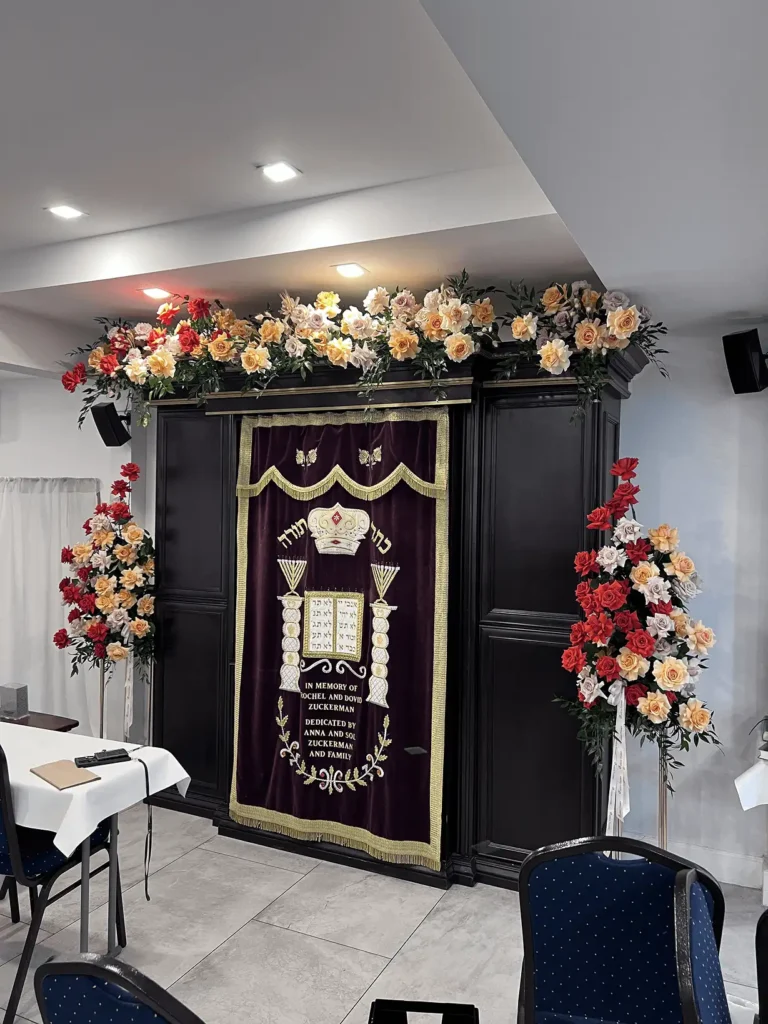
Jewish Holidays Celebrated in the Synagogue
Event floral décor can also be created for weddings, Bar Mitzvahs, Brit Milah, Shabbat, business meetings, and other celebrations. For Shavuot, event flowers can turn separate arrangements into one complete visual concept instead of placing unrelated bouquets around the room.
Shabbat flower subscription
Fresh flowers are not only for holidays. Many families love having flowers at home every Shabbat, but Friday can be busy. A flower subscription makes this easier because flowers can arrive regularly without placing a new order each week.
The subscription page lists plans with 2 or 4 deliveries a month, starting from $120 per month, and notes that flowers are selected from premium seasonal blooms. It also mentions customizable delivery options, including preferred day, time, colors, and special requests.
For Jewish homes, this can be very practical. The Shabbat table feels ready before candle lighting, and the home keeps a sense of beauty and freshness week after week. It can also work for synagogues, hotel lobbies, condo lobbies, offices, and community spaces that want fresh flowers on a regular schedule.
How to make Shavuot flowers more meaningful
A generic bouquet can be beautiful, but a Shavuot arrangement should feel chosen for the holiday. Here are several ways to give the flowers more depth.
Add wheat or grasses
Wheat stalks and grasses connect directly with Chag HaKatzir, the Harvest Festival. They also make the flowers feel less generic and more seasonal.
Choose a basket
A basket arrangement can reference bikkurim, the first fruits brought to the Temple. It is also practical because it arrives ready to display.
Use fruit-inspired colors
Pomegranate red, grape purple, fig tones, olive green, date-honey gold, and wheat beige can hint at the Seven Species without turning the arrangement into a literal fruit display.
Include fragrant flowers
Stock, garden roses, and other fragrant flowers can connect with the Shavuot tradition of fragrance. This is a subtle detail, but it gives the arrangement depth.
Consider flame colors for synagogue décor
For a synagogue or large event, warm flowers can create a powerful visual connection to fire and revelation at Sinai. This is not the best direction for every home table, but it can be very meaningful in the right space.
FAQ
Are flowers required for Shavuot?
No. Flowers are a custom, not a requirement. Chabad explains that many communities decorate homes and synagogues with flowers and greenery for Shavuot, but customs vary.
Do Shavuot flowers have to be white?
No. White and green is classic, but Shavuot flowers do not have to be only white. Pastels, wheat tones, fruit-inspired colors, and flame colors can also be meaningful when they are connected to the holiday’s themes.
Are baskets good for Shavuot?
Yes. Baskets are especially appropriate because of the bikkurim tradition. They are also practical for gifting because the recipient does not need a vase.
What is the best Shavuot flower gift?
The easiest gifts are baskets, flowers in a box, vase arrangements, and orchid centerpieces. These arrive ready to place and are considerate for a busy host.
Can synagogue flowers be designed especially for Shavuot?
Yes. Synagogue flowers can be designed around Shavuot themes such as Mount Sinai in bloom, wheat harvest, bikkurim baskets, fragrant flowers, or fire and revelation. More information about event floral décor is available here: (https://esteeflower.com/events).
Is there a regular flower subscription for Shabbat?
Yes. A flower delivery subscription can be used by families, synagogues, offices, hotels, and condo lobbies that want fresh seasonal flowers regularly. Subscription details are available here: (https://esteeflower.com/flower-delivery-subscription/).
Final thoughts
Shavuot flowers should not feel like a regular spring bouquet with a holiday name attached. When we choose flowers for this holiday, we think about Mount Sinai blooming, the wheat harvest, bikkurim baskets, fragrant flowers, first fruits, dairy meals, family gatherings, and the fire of revelation.
For a home table, that may mean peonies, roses, hydrangeas, tulips, stock, ranunculuses, chamomiles, baby’s breath, orchids, or soft greenery. For a gift, it may mean a basket, box, vase arrangement, or orchid centerpiece that does not require extra work from the host. For a synagogue or larger event, it may mean a full floral concept built around greenery, wheat, baskets, fruit tones, or flame colors.
That is the difference between simply sending flowers and choosing flowers that truly belong to Shavuot.
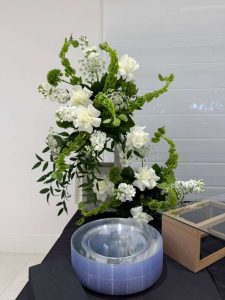
Synagogue flowers